
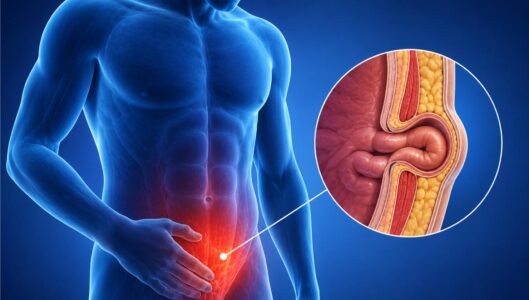
A hernia occurs when an internal organ or tissue pushes through a weak spot in the surrounding muscle wall. It does not always hurt. Some people discover one on a routine scan and stay symptom-free for years. However, sometimes people experience a dull ache that worsens with lifting or physical activity and gradually becomes harder to ignore. Even a symptom-free hernia can become severe on any given day and require surgery.
When the surgery is an emergency rather than a choice of procedure, recovery becomes more complicated. That is why it is important to know about the hernia pain symptoms so that you can get treated in time. Read on to learn more.
What is a Hernia?
A hernia occurs when some part of your body starts bulging through a weakness in the muscle. These usually involve an abdominal organ pushing through a wall of the abdominal cavity. The most common types of hernias are inguinal, femoral, and umbilical hernias. As you grow older, the wear and tear your muscles go through starts to add up, making you more likely to develop a hernia. Other than this, a hernia can also be caused by surgery, an injury, or a birth disorder.
Some of the most common locations for hernia are:
- The lower chest through the diaphragm
- The front midline of the abdomen
- The groin through the lower abdominal wall
- Through an incision from a former abdominal surgery
Most types of hernia aren’t serious. However, over time, they can become serious, especially if they get stuck in the hole they’re being pushed through. If it cannot go back in, it can cause a lot of pain. Sometimes, the tissue is cut off from its blood supply, resulting in tissue death (necrosis). Since hernias worsen over time and may eventually require a surgery.
What are the Symptoms of Hernia?
What are the Causes of a Hernia?
When there is a preexisting opening or a weakness in muscle or connective tissue, an organ or tissue may push through the opening, causing a hernia. In some people, this opening or weakness is present at birth. However, in most cases, it develops during their lifetime, maybe through a surgery or an injury. A repetitive stress injury that causes years of exertion and pressure can also create this opening.
There are certain risk factors that make it more likely for you to develop a hernia:
- A job that requires standing for hours or heavy lifting
- Chronic constipation that causes you to strain during bowel movements or urination
- Allergies or a chronic cough that causes sneezing
- History of pelvic or abdominal surgery
- Repeat pregnancies
- Chronic obesity
Some children are more likely to have a congenital hernia if they are born prematurely and have a condition like cystic fibrosis, congenital hip dysplasia, a connective tissue disorder, undescended testicles, and other problems in the urinary or reproductive system.
When Should You See a Surgeon for Hernia Pain?
Initially, when you start feeling pain, your first consultation would be with your general practitioner. They will be able to diagnose the condition and give the first round of hernia treatment. However, if the issue persists, you might have to see a general surgeon who treats the conditions affecting the groin, digestive system, abdomen, and soft tissues. A surgeon can provide detailed advice on whether surgery is needed for a hernia.
You might want to book a consultation with a surgeon if:
- The bulge or the lump is not going away on its own
- The pain and discomfort in the abdomen, groin, or around the belly button is intensifying
- The symptoms of hernia have started to impact your movement, work, and quality of life
- You have received a hernia diagnosis and want to know about your options
Talking to a general surgeon will help you get clear, practical advice. Often, the surgeon recommends monitoring the hernia rather than operating straight away. But sometimes, you might need emergency surgery.
What are the Treatment Options for a Hernia?
Hernias tend to get worse over time, which is why doctors recommend surgery. Other than the umbilical hernias in babies, hernias don’t resolve on their own.
Hernia repair surgery is a minor procedure in which the surgeon pushes the herniated tissue back into place. The barrier is reinforced with a surgical mesh or stitches. Most of the time, minimally invasive procedures are used for hernia repair, which means the incisions are smaller and recovery is quicker. The two most common types of minimally invasive procedures used for hernia are laparoscopic surgery and robotic surgery.
In most cases of congenital umbilical repair, no treatment is needed, as it resolves on its own as the child grows. However, in rare situations, the child will need surgery. A hiatal hernia doesn’t need repair unless it starts causing chronic acid reflux. To treat this, a Nissen fundoplication might be done to repair the procedure. This procedure involves wrapping and stitching the upper stomach to the lower oesophagus.
Conclusion
Dull, intermittent hernia pain can wait until a scheduled appointment. However, if the hernia is causing pain that is sudden, severe, or accompanied by nausea and vomiting, it needs emergency care. Most people delay seeing a surgeon longer than they should, either because the symptoms come and go or because the bulge doesn’t seem serious. A hernia does not resolve on its own, so you will eventually have to get it repaired. A surgeon can check whether your hernia requires intervention now or can be monitored. The earlier it is evaluated, the more options you have.